
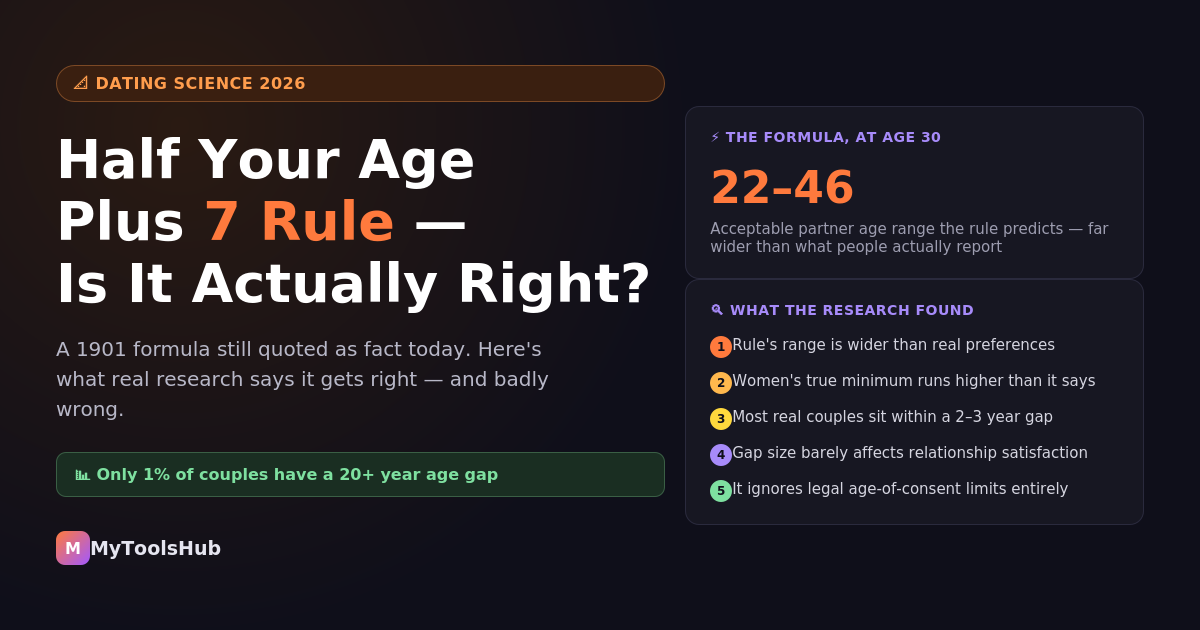
Half Your Age Plus 7 Rule: Is the Dating Age Gap Formula Actually Right? (Free Calculator)
Someone always brings it up. A friend starts dating someone younger, or older, and within minutes somebody at the table says it: "half your age plus seven." It sounds like a rule. It sounds official, almost mathematical, like something a scientist worked out in a lab. People repeat it with total confidence, as if it settles the argument.
It doesn't. The formula is over a century old, was never based on any research, and — according to actual studies on what people find acceptable — it's often more lenient than what most people, especially women, actually consider comfortable. So where did it come from, does it hold up, and what does modern research say about age gaps instead? We worked through the history, the math, and the data so you don't have to guess.
What Is the Half-Your-Age-Plus-7 Rule?
The formula is simple. Take your age, divide it by two, and add seven. That number is the youngest age you should, according to the rule, consider dating. There's a second half most people forget: to find your maximum, subtract seven from your age and double it.
| Your Age | Minimum Partner Age (÷2 + 7) | Maximum Partner Age ((age−7)×2) |
|---|---|---|
| 20 | 17 | 26 |
| 25 | 19.5 | 36 |
| 30 | 22 | 46 |
| 40 | 27 | 66 |
| 50 | 32 | 86 |
Look closely at that last row. The rule says a 50-year-old could date an 86-year-old and it would be "acceptable." Nobody actually believes that. This is the first sign the formula isn't as scientific as it sounds — the maximum side, in particular, stretches into territory that doesn't match how people really think.
Where the Rule Actually Came From
The formula isn't a psychology finding. It traces back to a French writer named Max O'Rell, who included it in a 1901 book aimed at guiding men toward suitable brides. In the original version, it wasn't about a minimum age at all — it was O'Rell's formula for a groom's "ideal" bride: half his age, plus seven. Over the decades, the framing flipped. What started as advice for men picking younger wives slowly turned into a modern, gender-neutral "minimum age" guideline that people now apply in both directions.
So the honest answer is: there's no data behind it. It's a hundred-year-old cultural rule of thumb that happened to sound catchy enough to survive, get repeated, and eventually go viral on TikTok and Reddit as if it were settled science.
Calculate It Yourself
Curious what your own range looks like under the formula — or want the exact age gap between you and someone else down to the year, month, and day? Our Age Difference Calculator does the precise math instantly, no guessing or manual subtraction required. If you just want to know your own current age in years, months, and days, our Age Calculator does that in one step.
Enter two birthdates and get the precise age gap in years, months, and days.
Try the Age Difference Calculator →
What Actual Research Says About Age Gap Preferences
This is where things get interesting, because researchers have actually tested the rule against real people's stated preferences — and the results don't match up cleanly.
A widely cited 2010 study by Buunk and colleagues asked men and women across different age groups what minimum and maximum partner age they'd personally find acceptable. When researchers plotted the real answers against what the half-your-age-plus-seven formula predicts, a pattern emerged: the rule's minimum-age line tracked reasonably close to what men reported, but it consistently underestimated what women considered their actual minimum. Women in their 40s, for example, reported being comfortable with partners around 35 or older — notably higher than the rule's suggested floor.
The maximum-age side of the rule fared even worse. The formula claims a 30-year-old woman could comfortably date someone up to 46. In reality, surveyed women in their 30s reported a personal ceiling closer to 37 — nearly a decade below what the formula allows.
A more recent and much larger study, led by researcher Jaroslav Gottfried and published in 2024 in the journal Personal Relationships, analyzed data from nearly 36,000 couples across 28 European countries and Israel. It found that at the start of a new relationship, a typical 25-year-old man partnered with a woman around 22, while a typical 25-year-old woman partnered with someone around 28. In other words, real-world pairing patterns skew much closer together than the wide range the half-plus-seven formula technically permits.
Rule's Prediction vs. What People Actually Prefer
What the Formula Says
30-year-old woman's max partner age: 46
50-year-old's min partner age: 32
Applies equally regardless of gender or life stage
What Research Found
30-year-old woman's real max preference: ~37
Women's minimum preference rises faster with age than the rule assumes
Preferences shift meaningfully by gender and age bracket
Illustrative summary based on Buunk et al. (2010) and related survey data — not a precise clinical measure.
How Common Are Big Age Gaps, Really?
Despite how often age-gap relationships come up in conversation — and how much attention they get online — they're actually the exception, not the norm. Recent analysis of long-term marriage data shows that same-age or close-in-age couples make up the clear majority of pairings, and that share has been growing rather than shrinking over the past couple of decades. Relationships with a 20-year-plus gap remain a small minority, statistically speaking, even though they tend to dominate headlines and social media commentary precisely because they stand out.
That's worth sitting with for a second. Age-gap couples generate outsized conversation not because they're common, but because they're unusual enough to comment on — the "same-age couple celebrates ten years together" story just doesn't write itself the same way.
Where the Rule Breaks Down Completely
The formula genuinely falls apart at the younger end of the age spectrum, and this is the part that matters most. Plug in an 18-year-old, and the rule spits out a minimum acceptable partner age of 16. Plug in a 20-year-old, and the floor drops to 17 — which is below the legal age of consent in several U.S. states and many countries outright.
This isn't a minor technicality. No professional body — not the American Psychological Association, not any equivalent organization elsewhere — endorses the half-your-age-plus-seven formula as a clinical, legal, or safety guideline. It was never designed with legal frameworks in mind, and treating it as one creates real risk. If a relationship involves anyone under 21, the formula's output should be ignored entirely in favor of your specific country or state's actual legal age of consent, which you should check directly rather than estimate.
Does Age Gap Actually Predict Relationship Success?
Here's a genuinely reassuring finding buried in the research: several studies looking at relationship satisfaction have found little meaningful difference in reported happiness between couples with a 5-year gap and couples with a 15-year gap. The size of the gap itself isn't a strong predictor of how a relationship turns out. What tends to matter far more is whether both partners are at similar life stages, share communication styles, and are entering the relationship as psychological equals — not whether their birth years happen to line up.
That said, some patterns do show up in larger datasets. Bigger gaps are statistically associated with somewhat shorter average relationship duration in Western countries, and socioeconomic factors — rather than age itself — often explain a chunk of that variance. Correlation isn't causation here; couples with wide age gaps often differ in other ways too (career stage, financial stability, family pressure) that independently affect longevity.
Frequently Asked Questions
Is the half-your-age-plus-seven rule scientifically proven?
No. It originated from a 1901 book with no research behind it. Modern studies show it's a rough cultural guideline at best, and it consistently misjudges women's actual preferences, especially at the upper age boundary.
Does the rule work the same for men and women?
Not according to survey data. The formula's minimum age tracks closer to what men report as acceptable, but underestimates what women say they actually prefer as they get older.
Is a large age gap bad for a relationship?
Research doesn't show a big satisfaction gap between couples with a 5-year difference and those with a 15-year difference. Compatibility factors matter more than the number itself.
What should I actually check before relying on any age formula?
Your local age of consent laws. They vary by state and country and always override any informal dating rule, including this one.
The Verdict
The half-your-age-plus-seven rule is catchy, easy to calculate, and has survived over a century of repetition — but it was never built on research, and modern data shows it often gets the boundaries wrong, especially on the maximum side and especially for younger ages. Treat it as a conversation starter, not a rulebook. If you want the real number for your own situation — the exact gap in years, months, and days between you and someone else — skip the mental math and let a calculator do it properly.
Get the precise age gap between any two dates in seconds, or check your own current age instantly.
Open the Age Difference Calculator → Open the Age Calculator →


Comments (0)
Leave a Comment