
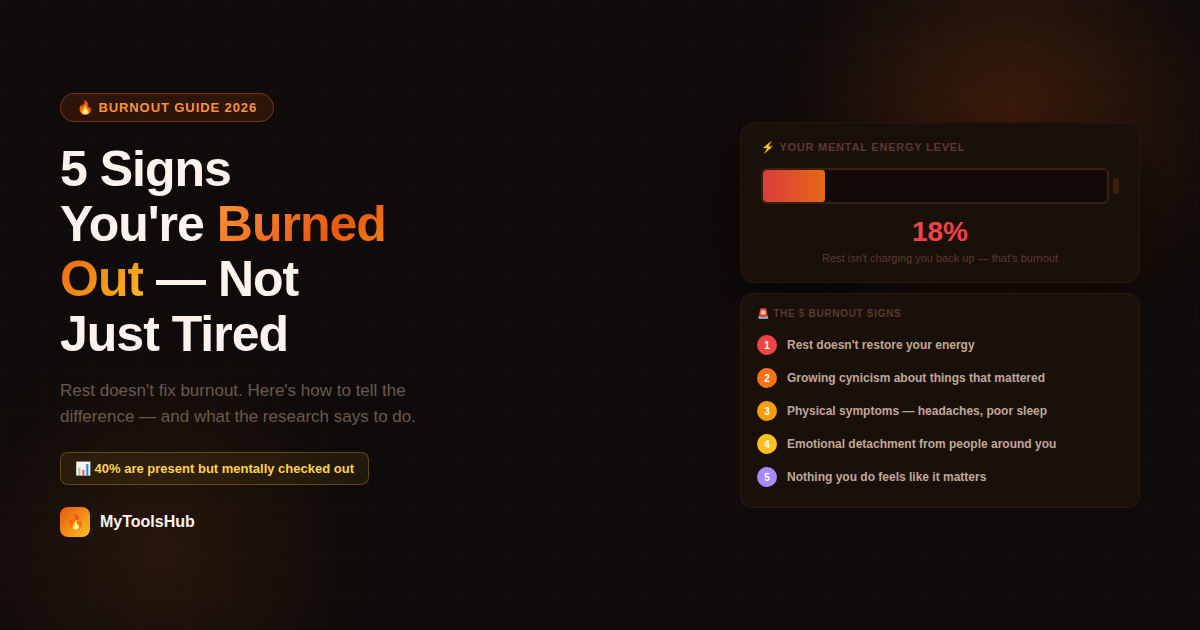
5 Signs You're Burned Out (Not Just Tired) — And What the Research Says to Do
There is a version of exhaustion that sleep fixes. You have a brutal week, you rest over the weekend, and Monday morning you feel — if not perfect — at least functional again. That is normal tiredness doing what it's supposed to do.
Then there is the other kind. You sleep eight hours and wake up already exhausted. You take a holiday and come back feeling exactly the same. Rest doesn't restore you because what's depleted isn't just energy — it's something deeper. That is burnout, and it behaves by completely different rules.
Spring Health's 2026 report, which surveyed more than 1,500 full-time employees, found that 40% of burned-out employees report being physically present but mentally checked out at work. Mental Health UK's Burnout Report 2026, based on a YouGov poll of 4,502 UK adults, found that burnout is no longer limited to high-pressure professions — it is affecting people across all walks of life. Understanding whether what you're experiencing is ordinary tiredness or burnout changes what you should do about it — because the interventions are genuinely different.
What Burnout Actually Is — The WHO Definition
Burnout is recognised by the World Health Organization as an 'occupational phenomenon'. While it is not classified as a medical or mental health condition, it has been classified as a syndrome — a collection of symptoms associated with a specific health-related cause.
The WHO's definition specifies three core components that together constitute burnout, and all three need to be present:
- Emotional exhaustion — feeling chronically drained of emotional and physical energy
- Depersonalization — developing a cynical, detached, or negative attitude toward work, responsibilities, or other people
- Reduced personal accomplishment — feeling that nothing you do makes a meaningful difference
This three-part framework matters because it separates burnout from plain exhaustion (which lacks the cynicism and detachment dimensions) and from depression (which tends to be more pervasive and less tied to a specific external context). Addressing burnout early can prevent long-term mental health struggles — if left unaddressed, it can lead to clinical depression or anxiety disorders.
5 Signs That Separate Burnout From Being Tired
Burnout vs Depression — The Overlap That Matters
Burnout and depression share enough symptoms that they can be genuinely difficult to distinguish without professional evaluation. Both can involve fatigue, difficulty concentrating, withdrawal, and loss of motivation. The key differences:
| Factor | Burnout | Depression |
|---|---|---|
| Primary cause | Identifiable external stressor (work, caregiving, prolonged demand) | Often no single identifiable cause |
| Scope | Often linked to a specific context (work, role) | Pervasive across all areas of life |
| Response to reduced stress | Often improves when stressors are reduced | Persists even when external circumstances improve |
| Emotional tone | Emptiness, cynicism, detachment | Sadness, hopelessness, worthlessness |
| Physical symptoms | Common (headaches, sleep disruption, illness) | Common (fatigue, appetite change, psychomotor changes) |
This distinction matters practically: burnout often responds well to addressing its root causes directly — reducing workload, setting boundaries, taking genuine recovery time. Depression typically requires professional treatment to resolve. Mental Health America notes that burnout results from prolonged stress and is different from depression, and that addressing it early can prevent long-term mental health struggles. When in doubt, a qualified healthcare professional is the appropriate person to help distinguish between them.
What Actually Helps — Recovery Strategies With Research Support
Burnout recovery isn't simply about resting more. Because the underlying cause is sustained demand without adequate recovery, the interventions that work are those that address this imbalance directly.
Address the Source, Not Just the Symptoms
Rest alone doesn't resolve burnout if you return to the same conditions that caused it. Mental Health America recommends identifying what's causing burnout and brainstorming changes to lighten the load — adjusting routine or responsibilities, talking to others about taking on tasks, and looking into community support services if caregiving is a contributing factor. Without addressing the source, symptom management is a temporary patch on a structural problem.
Genuine Recovery Requires More Than a Long Weekend
Mild burnout may respond to taking proper time off — not staycations where you're still checking messages, but genuine disconnection. In 2026, creating clear limits between work and personal time, turning off notifications, and prioritizing rest are among the most recommended practical first steps. For more established burnout, longer recovery periods are typically needed, and the research consistently shows that outcomes are better when people return to work gradually with adjusted conditions rather than jumping back into full load.
Boundaries Are an Active Intervention, Not a Passive One
Setting limits on what you take on — learning to decline additional responsibilities when already at capacity, defining working hours and sticking to them — is a behavioural intervention with a measurable effect on burnout recovery and prevention. This is harder than it sounds, particularly in workplace cultures that reward constant availability. But the research is consistent: sustainable performance requires sustainable inputs, and chronic overcommitment produces diminishing returns before it produces burnout.
Social Support — Even When You Don't Feel Like It
Burnout drives social withdrawal, and social withdrawal worsens burnout. Breaking this cycle often requires reaching out before you feel ready. WebMD recommends turning to friends and family to talk about how you're feeling, engaging socially, and talking with colleagues — while avoiding interacting with people who consistently drain you further. The quality and nature of social connection matters: supportive, low-demand interaction is restorative; high-expectation or high-drama interaction can increase rather than reduce the load.
Professional Support When It's Beyond Self-Management
For burnout that has been present for months, is severely affecting daily functioning, or is accompanied by symptoms of depression or anxiety, professional support is the appropriate next step rather than an optional extra. Mental Health America notes that if you are experiencing several burnout signs, it may be time to seek help — and in crisis, 24/7 help is available at 988 (US). A therapist or psychologist can help address both the symptoms and the underlying patterns (perfectionism, difficulty delegating, inability to set limits) that make certain people more vulnerable to burnout in the first place.
Burnout Beyond the Workplace — The 2026 Reality
In 2026, burnout is no longer limited to high-pressure jobs or demanding careers — it's affecting people across all walks of life, from professionals and students to caregivers and parents. Mental Health UK's Burnout Report 2026 found that the experience of burnout has expanded significantly beyond the occupational context that the WHO's original classification focused on.
Caregiver burnout — experienced by people supporting elderly parents, children with medical needs, or other dependents — follows the same mechanism: sustained demand without adequate recovery, and the same feeling of depleted resources with no clear end in sight. Student burnout, particularly among those managing academic pressure alongside financial stress and social demands, has become increasingly recognized in university health services. Even the constant connectivity of digital life — the always-on nature of smartphones and the social and informational demands of social media — has been linked to a form of ambient burnout that isn't tied to any single role.
The mechanism is the same regardless of context: chronic depletion without recovery. And the recovery principles are the same too: reduce the demand, increase the recovery, address the source, and seek support when self-management isn't enough.
Frequently Asked Questions
What is the difference between burnout and being tired?
Regular tiredness resolves with rest. Burnout doesn't — rest provides temporary relief but the exhaustion returns. Burnout also includes emotional detachment and cynicism that normal fatigue doesn't produce. If a good night's sleep consistently fails to restore your energy, and you're noticing growing cynicism and feeling that your efforts don't matter, burnout is the more likely explanation.
Is burnout the same as depression?
They share overlapping symptoms but differ in important ways. Burnout typically has an identifiable external cause and may improve when that cause is reduced. Depression tends to be more pervasive, affecting all areas of life equally regardless of external circumstances. If you're unsure which applies, a qualified mental health professional can help distinguish between them.
How long does it take to recover from burnout?
Mild burnout caught early may improve within weeks of reducing stressors. Severe or long-standing burnout can take months and typically requires addressing the underlying causes alongside symptom management. Recovery is faster when the source stressors are reduced, not just when symptoms are managed.
Can burnout happen outside of work?
Yes. While the WHO classifies burnout as an occupational phenomenon, its causes in 2026 have expanded to include caregiving, parenting, student pressure, and even the chronic demands of digital connectivity. The core mechanism — prolonged demand exceeding recovery — applies regardless of context.
What are the first signs of burnout?
Emotional exhaustion is the earliest and most central indicator — feeling drained at the end of every day regardless of workload. This is typically followed by growing cynicism, difficulty with tasks that previously felt manageable, physical symptoms like headaches or disrupted sleep, and a sense that efforts aren't making a difference.
For overall health alongside mental wellbeing, you can also check your BMI, daily calorie needs, or exact age — physical and mental health are more closely connected than most people realize.

Comments (0)
Leave a Comment