
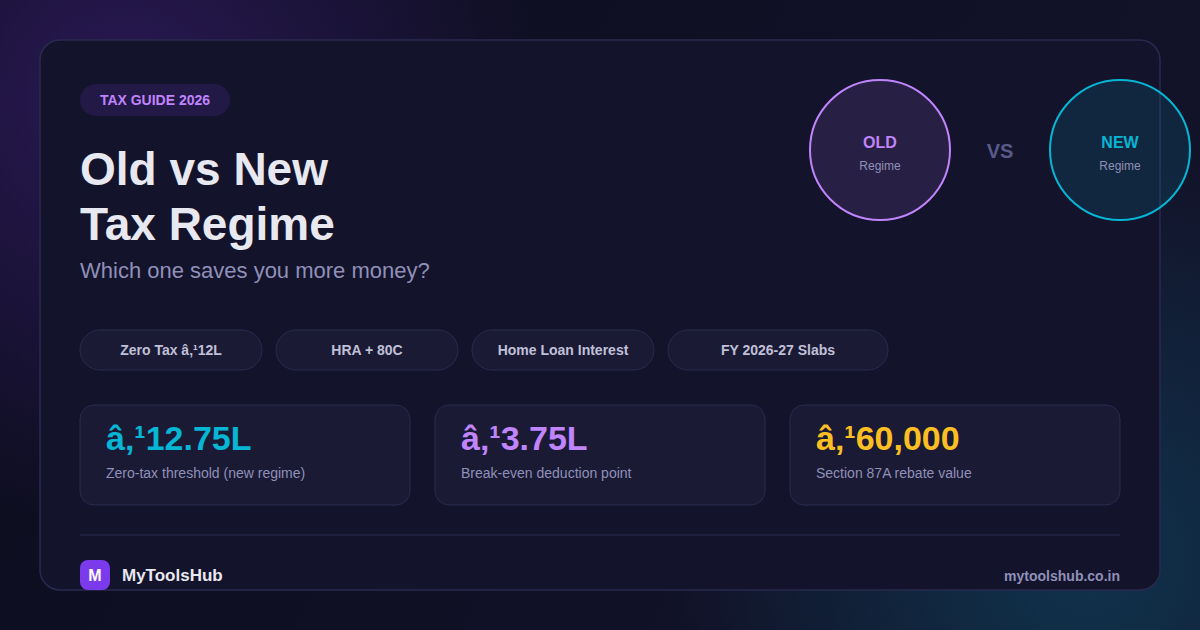
Old vs New Tax Regime: Which One Saves You More Money in 2026?
Since Union Budget 2025, India's income tax landscape has a genuinely interesting development: for the first time, a large portion of salaried middle-class taxpayers have zero tax liability under the new regime. Income up to ₹12 lakh — and for salaried employees, up to ₹12.75 lakh after standard deduction — attracts no income tax at all under the new regime's Section 87A rebate. This has changed the calculus of the old vs new regime question significantly.
Yet the answer isn't "new regime is always better." For someone with substantial deductions — a home loan, significant 80C investments, and paying rent — the old regime can still come out ahead. The decision depends on your specific numbers, not a general rule. This article walks through both regimes clearly, shows you where each one wins, and gives you the comparison table you need to make the decision for your income level.
The New Tax Regime Slabs for FY 2026-27
The new regime is the default for FY 2026-27. If you don't explicitly opt for the old regime, the new regime applies automatically. The slab structure:
| Income Slab | Tax Rate (New Regime) |
|---|---|
| Up to ₹4,00,000 | Nil |
| ₹4,00,001 – ₹8,00,000 | 5% |
| ₹8,00,001 – ₹12,00,000 | 10% |
| ₹12,00,001 – ₹16,00,000 | 15% |
| ₹16,00,001 – ₹20,00,000 | 20% |
| ₹20,00,001 – ₹24,00,000 | 25% |
| Above ₹24,00,000 | 30% |
The Section 87A rebate of ₹60,000 eliminates tax for anyone with taxable income up to ₹12 lakh. For salaried employees, the standard deduction of ₹75,000 under the new regime means gross income up to ₹12.75 lakh results in zero tax — this is the "₹12 lakh zero tax" benefit that was introduced in Budget 2025.
The Old Tax Regime Slabs for FY 2026-27
| Income Slab | Below 60 years | Senior Citizens (60–80) | Super Senior (80+) |
|---|---|---|---|
| Up to ₹2.5 lakh | Nil | Nil | Nil |
| ₹2.5 – ₹3 lakh | 5% | Nil | Nil |
| ₹3 – ₹5 lakh | 5% | 5% | Nil |
| ₹5 – ₹10 lakh | 20% | 20% | 20% |
| Above ₹10 lakh | 30% | 30% | 30% |
The old regime's slab rates are higher, but it allows a wide range of deductions and exemptions that can substantially reduce taxable income before the slabs are applied.
What You Can Deduct Under the Old Regime
- Section 80C (up to ₹1,50,000): PPF, ELSS mutual funds, LIC premiums, home loan principal repayment, NSC, 5-year bank FD, children's tuition fees, Sukanya Samriddhi
- Section 80D (up to ₹25,000 / ₹50,000 for senior citizens): Health insurance premiums for self, spouse, and children; additional ₹25,000 / ₹50,000 for parents
- HRA Exemption: House Rent Allowance — exemption calculated as the minimum of: actual HRA received, 50% of basic salary (40% for non-metro cities), or actual rent paid minus 10% of basic salary
- Home Loan Interest (Section 24b, up to ₹2,00,000): Interest paid on home loan for self-occupied property
- Standard Deduction (₹50,000): Available for salaried employees and pensioners
- LTA (Leave Travel Allowance): Exempt for domestic travel expenses for self and family
- NPS Additional Deduction (Section 80CCD(1B), up to ₹50,000): Over and above 80C limit
- Section 80E: Interest on education loan (no upper limit, for 8 years)
- Section 80G: Donations to eligible charitable institutions (50% or 100% depending on the institution)
The Break-Even Point — When to Choose Which Regime
The critical question isn't which regime has lower rates — it's which regime produces a lower actual tax liability for your specific income and deductions. Here's how they compare at common income levels:
| Annual Income | Low Deductions (<₹1.5L) | Medium Deductions (₹1.5–3L) | High Deductions (>₹3.75L) |
|---|---|---|---|
| Up to ₹12.75 lakh | New Regime ✅ | New Regime ✅ | New Regime ✅ |
| ₹12.75L – ₹15L | New Regime ✅ | New Regime ✅ | Old Regime ✅ |
| ₹15L – ₹20L | New Regime ✅ | Compare both | Old Regime ✅ |
| ₹20L – ₹30L | New Regime ✅ | Compare both | Old Regime ✅ |
| Above ₹30L | New Regime ✅ | Compare both | Old Regime ✅ |
The approximate crossover point is around ₹3.75 lakh in total deductions. If your eligible deductions under the old regime exceed this amount, the old regime typically saves more despite its higher headline rates. Below this threshold, the new regime's lower rates and zero-tax rebate generally produce a better outcome.
Worked Example: ₹15 Lakh Salary — Which Regime Wins?
Let's calculate for a salaried employee with ₹15 lakh gross income and typical deductions:
| Item | Old Regime | New Regime |
|---|---|---|
| Gross Income | ₹15,00,000 | ₹15,00,000 |
| Standard Deduction | –₹50,000 | –₹75,000 |
| Section 80C | –₹1,50,000 | Not allowed |
| Section 80D | –₹25,000 | Not allowed |
| HRA Exemption | –₹60,000 | Not allowed |
| Home Loan Interest | –₹1,50,000 | Not allowed |
| Taxable Income | ₹10,65,000 | ₹14,25,000 |
| Tax Payable | ≈ ₹1,23,500 | ≈ ₹1,73,750 |
In this example with ₹3.85 lakh in deductions, the old regime saves approximately ₹50,250 per year. However, if the same person had no home loan and was not paying rent (removing ₹2.1 lakh in deductions), the new regime would be better.
Key Changes Under Budget 2025 That Affect Your Decision
- Zero tax up to ₹12 lakh: Section 87A rebate increased to ₹60,000 under the new regime — this is the biggest single change and makes the new regime definitively better for anyone below this threshold.
- Standard deduction under new regime increased to ₹75,000: Up from ₹50,000, giving salaried employees more benefit under the new regime without requiring any investment proof.
- TDS limit on rent increased to ₹50,000/month: Applicable from FY 2025-26.
- Senior citizen savings interest deduction doubled: Section 80TTB limit increased from ₹50,000 to ₹1,00,000 under old regime — significant benefit for senior citizens with fixed deposit income.
- New regime is now the default: You must actively opt for the old regime — if you don't inform your employer, new regime applies automatically.
Who Should Definitely Choose the Old Regime
- Anyone with a home loan with significant outstanding balance (getting the full ₹2 lakh Section 24b deduction)
- Those paying substantial rent who qualify for HRA exemption
- People who have already maximized 80C investments and pay health insurance premiums
- Individuals with NPS contributions who want the additional 80CCD(1B) deduction
- Senior citizens with high interest income from savings who benefit from the enhanced 80TTB
Who Should Definitely Choose the New Regime
- Anyone with gross income up to ₹12.75 lakh — zero tax applies, old regime cannot match this
- Young earners who have not yet built up 80C investments or don't own a home yet
- Those living in employer-provided accommodation (no HRA benefit anyway)
- People who prefer simplicity and don't want to track multiple investment proofs throughout the year
- Freelancers and self-employed individuals with limited eligible deductions
How to Make the Final Decision
The most reliable approach is to calculate your actual tax liability under both regimes with your real numbers. The steps:
- List all your eligible deductions — 80C investments, health insurance premiums, HRA (if renting), home loan interest, and any other applicable deductions
- Calculate taxable income under the old regime — Gross income minus standard deduction minus all eligible deductions
- Apply old regime slabs to get tax liability
- Calculate taxable income under the new regime — Gross income minus ₹75,000 standard deduction only
- Apply new regime slabs and check if 87A rebate applies (taxable income ≤ ₹12 lakh)
- Compare the two figures — the lower tax liability wins
Many people find the difference is ₹20,000–₹60,000 per year at mid-income levels — a meaningful amount worth the 15 minutes of calculation time.
Frequently Asked Questions
Which tax regime is better — old or new in 2026?
It depends on your deductions. If your total eligible deductions exceed approximately ₹3.75 lakh, the old regime typically saves more tax. If your income is below ₹12.75 lakh or your deductions are low, the new regime is almost always better due to the Section 87A rebate and lower rates.
Is income up to ₹12 lakh really tax-free in 2026?
Yes, under the new tax regime, a resident individual with taxable income up to ₹12 lakh pays zero tax due to the Section 87A rebate of ₹60,000. For salaried employees, the ₹75,000 standard deduction means gross salary up to ₹12.75 lakh results in zero tax. This does not apply to capital gains or other specially-rated income.
What deductions are available under the old tax regime?
Major deductions include: Section 80C (up to ₹1.5 lakh for PPF, ELSS, LIC, home loan principal); Section 80D (health insurance up to ₹25,000–₹50,000); HRA exemption for rent paid; home loan interest up to ₹2 lakh under Section 24b; and standard deduction of ₹50,000 for salaried employees.
Can I switch between old and new tax regime every year?
Salaried employees without business income can switch every year by informing their employer. Taxpayers with business or professional income can only switch once — they cannot re-enter the new regime after opting out.
What is the income tax slab for FY 2026-27 under the new regime?
New regime slabs: 0% up to ₹4L; 5% on ₹4–8L; 10% on ₹8–12L; 15% on ₹12–16L; 20% on ₹16–20L; 25% on ₹20–24L; 30% above ₹24L. Income up to ₹12 lakh effectively attracts zero tax due to the Section 87A rebate.
For broader financial planning, our BMR Calculator can help you plan your calorie and nutrition budget, and our Age Calculator is useful for checking senior citizen eligibility thresholds (age 60 and 80) that affect your tax slab rates under the old regime.


Comments (0)
Leave a Comment