
How Much Protein Do You Actually Need Per Day?
Walk into any gym, open any fitness app, or scroll through a nutrition forum, and you'll hit the same number almost immediately: 1 gram of protein per pound of body weight. It's repeated so often it sounds like established science. But where did it actually come from? And more importantly — is it right for you?
The short answer is that the real protein picture is more nuanced than any single number, because protein needs shift substantially depending on who you are, how old you are, and what you're asking your body to do. This article works through what the research actually says, broken down by the groups it matters most for.
The 0.8g/kg Number — What It Actually Means
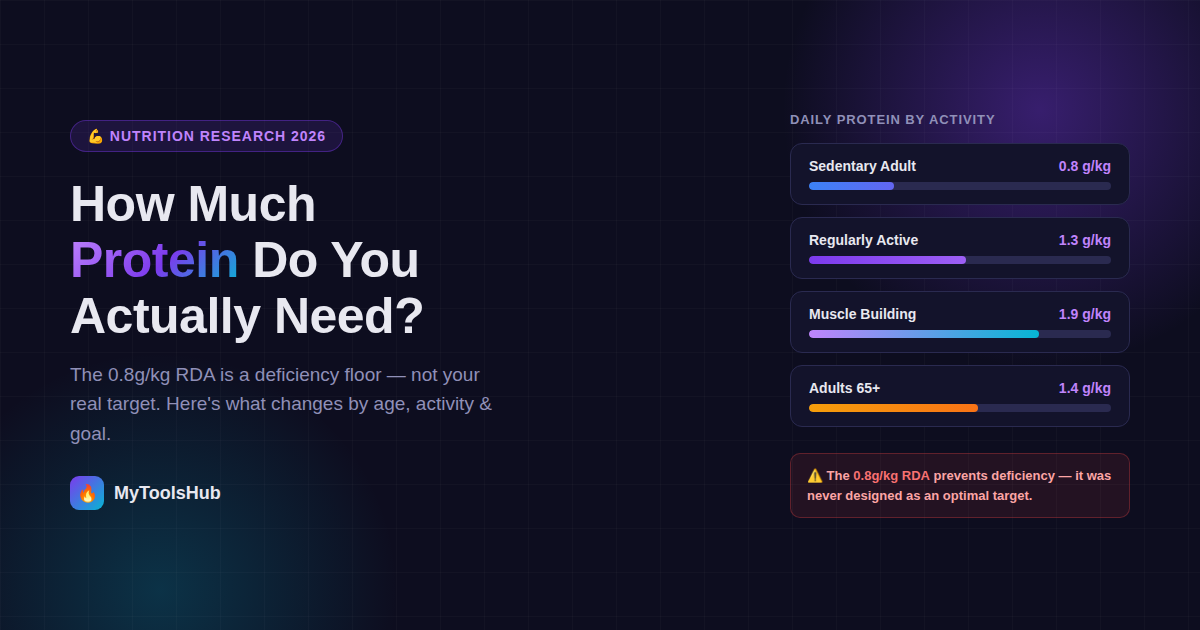
The figure most people know — 0.8 grams of protein per kilogram of body weight per day — is the official RDA (Recommended Dietary Allowance) set by nutrition authorities. For a 75kg adult, that works out to about 60 grams of protein a day.
Here's what that number was designed to do: prevent deficiency. It's a floor, not a ceiling. The RDA represents the minimum amount of protein a sedentary adult needs to avoid losing body protein over time, not the amount that optimizes muscle maintenance, performance, or aging. That distinction gets lost almost every time the number gets cited.
To put it concretely: if you do any regular exercise, are older than 40, or are actively trying to manage your body composition, the RDA is almost certainly below what your body actually benefits from. It's the nutritional equivalent of saying the minimum wage is what you should aim to earn — technically true as a floor, not useful as a goal.
Protein Needs by Who You Actually Are
Rather than one number for everyone, here's what the research supports broken down by the groups it actually applies to:
Sedentary Adults
For genuinely sedentary adults — desk jobs, minimal exercise, no structured training — the 0.8g/kg RDA is broadly adequate to prevent muscle loss in younger adults. Mayo Clinic's current guidance puts this range at 0.8–1.0g/kg for sedentary individuals. Most adults eating a reasonably varied diet hit this target without thinking about it or tracking anything.
Adults Who Exercise Regularly
Regular exercise — even moderate activity like 3-4 sessions per week — increases the body's demand for protein because muscle tissue is being broken down and rebuilt more actively. Research consistently places the effective range for regularly active adults at 1.1–1.5g/kg per day. This is where a meaningful gap opens between "enough to prevent deficiency" and "enough to support the adaptation your training is actually asking for."
Strength Training and Muscle Building
For adults doing consistent resistance training with a goal of building or maintaining muscle mass, the research converges on a clear range. Studies support 1.6–2.2g/kg per day as the effective range for muscle protein synthesis — the process by which your body actually builds new muscle tissue. Intakes above 2.2g/kg don't appear to produce additional muscle-building benefit in most research populations, so this is also a practical ceiling for most people.
Endurance Athletes
Endurance athletes have different — and often underappreciated — protein needs compared to strength athletes. During prolonged aerobic exercise, the body begins burning amino acids from muscle tissue as fuel, particularly when carbohydrate stores run low. Research places optimal protein intake for endurance athletes at 1.2–1.6g/kg per day, with the higher end of that range more relevant for high-volume training blocks.
The Full Reference Table
| Who You Are | Recommended Range | Practical Example (70kg person) |
|---|---|---|
| Sedentary adult | 0.8 – 1.0 g/kg/day | 56 – 70g/day |
| Lightly active (walks, casual exercise) | 1.0 – 1.2 g/kg/day | 70 – 84g/day |
| Regularly active (3–5x/week exercise) | 1.1 – 1.5 g/kg/day | 77 – 105g/day |
| Endurance athlete | 1.2 – 1.6 g/kg/day | 84 – 112g/day |
| Resistance training / muscle building | 1.6 – 2.2 g/kg/day | 112 – 154g/day |
| Adult 40–65 (any activity level) | 1.0 – 1.2 g/kg/day | 70 – 84g/day |
| Adult 65+ (any activity level) | 1.2 – 1.6 g/kg/day | 84 – 112g/day |
Notice that older adults appear twice in this table, once in the age-based rows and once implied in the activity rows. That's intentional — age is an independent factor that pushes protein needs upward regardless of exercise status, which the next section explains.
Why Age Changes Everything After 40
Starting somewhere between age 40 and 50, the body's ability to efficiently use dietary protein for muscle building begins to decline. The process — called anabolic resistance — means that older adults need a higher protein stimulus to achieve the same muscle protein synthesis response that a younger adult gets from a smaller amount.
Alongside anabolic resistance, adults also begin losing muscle mass at a rate of roughly 3–8% per decade after 30, accelerating after 60 — a process called sarcopenia. Adequate protein intake combined with resistance exercise is one of the most evidence-backed strategies to slow sarcopenia, but the protein target needs to rise to match the aging body's reduced efficiency.
Mayo Clinic's current guidance places protein needs for adults over 40–50 at 1.0–1.2g/kg per day regardless of exercise level, rising toward 1.2–1.6g/kg for those who are also physically active. This is meaningfully higher than the sedentary adult RDA, even for someone who isn't training for performance — just trying to maintain the muscle they have as they age.
The "1g Per Pound" Rule — Where It Came From
The "1 gram per pound of body weight" rule that's repeated endlessly in gym culture works out to roughly 2.2g/kg — the absolute upper end of what most research identifies as the effective range for muscle building. In other words, it's not wrong per se for competitive bodybuilders or heavy strength athletes, but it's set at the ceiling of the research range, not the middle of it.
For most people who exercise regularly but aren't competitive athletes, this rule overestimates needs by 30–50%, which primarily means spending more money on food and protein supplements than the evidence actually supports. The 1.6–2.0g/kg range covers the effective zone for most people doing regular strength training — the extra grams above that don't appear to translate into additional muscle.
Distribution Matters as Much as Total
One aspect of protein intake that gets far less attention than total daily grams is how that protein is distributed across meals. Muscle protein synthesis — the process of building new muscle tissue — isn't simply a function of how much protein you eat in a day. It's triggered meal by meal, and there appears to be a practical ceiling on how much a single meal can effectively stimulate it.
Research suggests that roughly 25–40g of protein per meal is the effective range for maximizing muscle protein synthesis in most adults, with the higher end more applicable to older adults due to anabolic resistance. Eating 150g of protein in one large meal doesn't produce the same response as spreading those grams across four well-spaced meals — the body can only process and use so much at once for muscle building, with excess calories going toward energy or other metabolic pathways.
This has a practical implication: if you're currently hitting your daily protein target but eating most of it at dinner, redistributing some of that protein into breakfast and lunch could improve the actual outcome even without changing your total intake.
| Meals Per Day | Target Per Meal (70kg active adult, 1.6g/kg total) |
|---|---|
| 2 meals | ~56g per meal — at the upper limit of effective range |
| 3 meals | ~37g per meal — within the optimal range |
| 4 meals | ~28g per meal — solid, on the lower-middle of effective range |
Protein Sources: Quality Alongside Quantity
Protein grams aren't all equal in practice, because different food sources provide different amino acid profiles. The body needs all nine essential amino acids — the ones it can't synthesize itself — and not all protein sources deliver all nine in adequate amounts.
- Complete protein sources (all nine essential amino acids): eggs, dairy, fish, poultry, red meat, soy, quinoa
- Incomplete sources (missing or low in one or more essential amino acids): most legumes, grains, nuts, seeds — though combining different plant sources across a day covers the gaps effectively
For people eating a varied diet that includes animal protein, amino acid completeness is rarely a concern. For people eating exclusively plant-based diets, it takes slightly more intentional food combining — not at every meal, but across the day — to ensure the full essential amino acid spectrum is covered. The total gram target remains the same regardless of source; the source just affects how effectively those grams are used.
A Note on Supplements
Protein supplements — powders, bars, shakes — are exactly what the name says: supplements to fill gaps in dietary intake, not replacements for food protein. Whole food protein sources come packaged with other nutrients (B vitamins from meat, calcium from dairy, fiber from legumes) that supplements strip out in isolating the protein itself.
Where supplements genuinely help is convenience: a 25g protein shake after a morning workout is faster than cooking chicken breast at 7am. But if your total daily protein needs can be met through regular food choices, the research doesn't support a reason to supplement beyond convenience preference. The muscle-building effect of 25g of protein from a shake and 25g from chicken breast is functionally the same.
Frequently Asked Questions
Is 0.8g of protein per kg enough?
It depends entirely on who you are. For a genuinely sedentary younger adult, 0.8g/kg prevents deficiency and maintains basic muscle tissue. For anyone who exercises regularly, is over 40, or is trying to build or maintain muscle, the evidence supports meaningfully higher targets — typically 1.2–2.0g/kg depending on the specific situation.
How much protein do I need to build muscle?
Research consistently places the effective range for muscle gain at 1.6–2.2g/kg of body weight per day. Going above 2.2g/kg shows no additional muscle-building benefit in most studies — those extra grams just become energy or get excreted.
Do protein needs change with age?
Yes, and significantly. Adults over 40–50 experience declining efficiency in using dietary protein for muscle building (anabolic resistance), which means their protein targets should be higher than what the basic sedentary RDA suggests — even without exercise. Current research supports 1.0–1.2g/kg for older sedentary adults, rising to 1.2–1.6g/kg for those who are also active.
Does it matter when I eat protein throughout the day?
More than most people realize. Research supports spreading protein across 3–4 meals, targeting roughly 25–40g per meal, as more effective for muscle protein synthesis than the same total eaten in one or two large servings. The body has a practical ceiling on how much protein it can use for muscle building in a single sitting.
Can you eat too much protein?
Intakes above 2.0–2.2g/kg/day don't appear to offer additional muscle or performance benefits. For healthy adults with normal kidney function, high protein intake is generally well tolerated, but there's no evidence-based reason to push significantly beyond what your activity level and goals actually require.
Post-Workout Protein: Does Timing Actually Matter?
The idea of a "anabolic window" — a narrow 30-minute slot after exercise where protein must be consumed to maximize muscle growth — was heavily promoted in gym culture for decades. The current research picture is more nuanced than that original framing suggested.
While the urgency of the 30-minute window has been largely revised downward, timing still carries some practical weight. Studies suggest that consuming protein within roughly 2 hours post-exercise — rather than waiting until a meal hours later — supports muscle protein synthesis during the recovery period when the muscle is most receptive to protein. For people who train in the morning and don't eat until midday, this means there's likely a practical benefit to having a post-workout protein source, even a small one, before the full meal.
Where the window metaphor gets overstated is in making people feel that missing the 30-minute mark means a wasted workout. The actual evidence suggests the window is considerably wider — closer to 2 hours — and that total daily protein intake across the whole day still matters far more than precise timing for the vast majority of people who aren't elite athletes optimizing every variable.
Plant Protein vs. Animal Protein: Does the Source Change Your Target?
Whether plant-based or animal-based protein is "better" is one of the more reliably polarizing nutrition debates, but the practical answer for most people is less dramatic than the debate suggests.
Animal proteins — eggs, meat, fish, dairy — are complete proteins that provide all nine essential amino acids in proportions closely matched to what human muscle tissue requires. They also tend to have high biological value, meaning a high proportion of the protein you eat actually gets absorbed and used.
Most individual plant proteins are technically incomplete — they're low or missing in one or more essential amino acids. Legumes tend to be low in methionine. Grains tend to be low in lysine. But the workaround is straightforward: eat a variety of plant protein sources across the day, and the gaps fill each other in. The classic example is rice and lentils together, which between them cover the full essential amino acid profile that neither covers adequately on its own.
The practical implication for people eating primarily plant-based diets is that the total gram target may need to be set slightly higher — some research suggests around 10–20% more — to account for lower bioavailability compared to animal proteins. So a plant-based eater who needs 120g/day based on the activity-level table above might aim for 130–140g/day to account for absorption differences. This isn't a dramatic adjustment, but it is worth factoring in if plant foods make up most of your protein intake.
| Protein Source | Complete? | Approx. Protein per 100g | Notes |
|---|---|---|---|
| Chicken breast | ✓ Yes | ~31g | High bioavailability, low fat |
| Eggs | ✓ Yes | ~13g (whole) | Near-perfect amino acid profile |
| Greek yogurt | ✓ Yes | ~10g | Also provides calcium |
| Lentils (cooked) | ✗ Incomplete | ~9g | Low in methionine; pair with grains |
| Tofu (firm) | ✓ Yes (soy) | ~8g | One of few complete plant proteins |
| Chickpeas (cooked) | ✗ Incomplete | ~9g | Good lysine; pair with grains |
| Quinoa (cooked) | ✓ Yes | ~4g | Complete but lower density |
| Whey protein powder | ✓ Yes | ~80g (dry) | Fast-absorbing; useful post-workout |
The Bottom Line
The 0.8g/kg RDA is a starting floor for preventing deficiency in a sedentary adult — not a universal target. If you exercise, if you're over 40, or if you're trying to build or maintain muscle, the research supports meaningfully higher protein intake than the number most people cite from memory.
The practical takeaway is this: identify which category you actually fall into, set your target from the appropriate range in the table above, and spread that protein across your day in 25–40g portions rather than loading it all into one meal. Get most of it from whole food sources, and use supplements only where convenience genuinely calls for them.
For your specific number based on your weight, activity level, and goal, our Protein Intake Calculator does the math instantly. You can also cross-reference your calorie needs alongside protein with our Calorie Calculator, since protein targets and total calorie targets are closely linked for most body composition goals.

Comments (0)
Leave a Comment